It is an undeniable fact that Beverly Cleary was a huge part of how several generations of children learned to read. It’s been forever Henry Huggins he arrived in 1950, and remains a top choice for active young readers despite his death in 2021 at the age of 104. Ramona again The Mouse and the Motorcycle books, rightly revered as classics. Despite being generations apart from when they were first written, children continue to connect with Cleary’s sincere style that never fails to throw a smile. Among his many books, there is one subplot that can be considered the most sensitive book the author has ever written, covering a topic rarely trodden on in children’s books written at the time.
First published four decades ago, in 1983, Mr. Dear Henshaw centers on a California boy named Leigh Botts, who aims to become a writer when he grows up. From the second grade, the teenager began a correspondence with the famous children’s author Boyd Henshaw, which continued for several years. During this time, Leigh is dealing with her parents’ recent divorce, trying to make sense of the confusing emotions caused by this trauma.
Mr. Henshaw answers Leigh’s sixth grade assignment to write a letter to the author with her own set of ten questions. The budding writer slowly and reluctantly answers probing questions like “Who are you?” or “How is your family?” As time goes on, Leigh finds that she enjoys writing to Mr. Henshaw, and the books become a form of therapy, eventually turning into a personal diary addressed to “Pretend Mr. Henshaw.” Leigh finds solace in this safe space, talking openly about her worries and concerns, like why her dad doesn’t say he misses her when they talk on the phone (when he remembers driving), and how Leigh doesn’t like being home alone after her mom leaves for work.
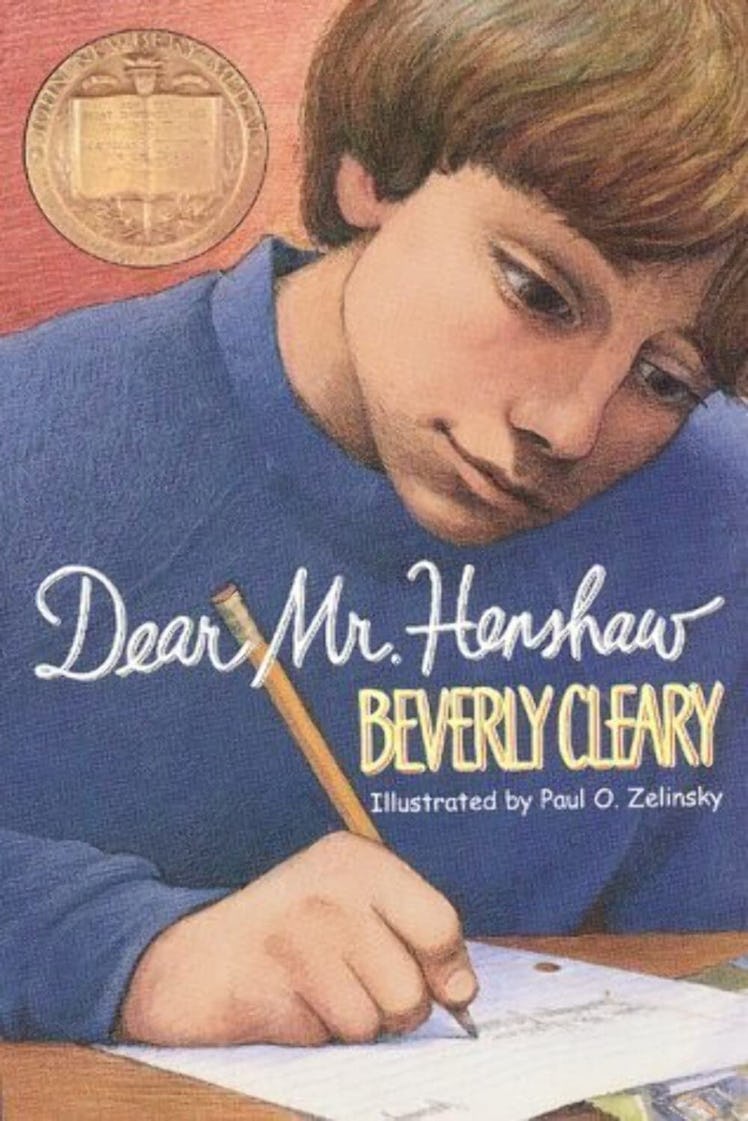
This original illustration from Paul O. Zelinsky shows Leigh writing to Mr. Henshaw, hesitant at first, but quickly warmed to the idea.
Paul O. Zelinsky/ HarperCollins
When Leigh answered his letter, the students of the Mr. Dear Henshaw never see a single word from the old author. The character is simply a guide for Leigh to open up, process her feelings, and allow herself to have this destiny. Between her time writing books and lessons from her teachers, Leigh’s skills as a writer matured at the same time as her emotional vocabulary grew. Finally, she is able to deal with her indifferent father, understand her mother’s pain, and realize that the divorce was not her fault, while enjoying her first success as a published author. No matter how much she wishes, Leigh’s world will never be the same, but like the butterflies she finds while walking along the beach (similar to the real Monarch Butterfly Grove in Pismo Beach), Leigh grows into something new and different, free to be who she is.
According to Beverly Cleary, Mr. Dear Henshaw it is the most important book he wrote during his lifetime. The story came about because two different boys wrote letters to her at the same time, asking why she didn’t write about the boy whose parents divorced. A spark lit up, and the letter went from his head to paper.
Cleary’s books were often not unique Mr. Dear Henshawand rarely goes into serious trauma. It has an exterior with a sad tone and a stable atmosphere, although Cleary’s signature humor from throughout his catalog of work is present. Leigh does not live in a crowded place surrounded by children, but lives alone “e indeed a small house,” where his neighbors are a gas station and a convenience store. He is tired of finding meaning in anything that goes on around him, trapped between spaces he does not know, physically and emotionally. After adding writing to his routine, his sense of abandonment disappears to allow for the personal growth that even older students can love and long for.
Mr. Dear Henshaw It covers many of the concerns that children feel during a divorce. It is not unusual for them to go through their temporary stages of grief, from madness to sadness, denying that the events are real while hoping that everything will go back to the way things were before, and finally accepting the new situation. Children may react to this outwardly with anger and resentment, while other children will internalize it and not show how they really feel. Cleary assures the reader that whatever they are going through is nothing to be ashamed of, and one can heal the invisible wounds in one’s heart.
Divorce is rarely an easy task, no matter how old you are. Processing the good memories alongside the bad is difficult, and often a source of confusion and frustration. Mr. Dear Henshaw It encourages the student not to be afraid to examine things that make them sad because the only way to grow is to deal with them in a healthy and thoughtful way.
Despite receiving the Newbery Medal when it was issued, Mr. Dear Henshaw is always overshadowed by Cleary’s most popular and light-hearted stories. It got a sequel eight years later with The Stridercenters around Leigh and her friend Barry sharing custody of a lost dog they find on the beach. Although it doesn’t reach the level of disappointment of its predecessor, it is a perfect follow-up of children who continue their journey through divorce.
Cleary’s books were a great piece of Americana, but the idea that change can be found in many of them. Mr. Dear Henshaw is a remarkable book that is as relevant today as it was 40 years ago, encouraging readers to look within and answer the difficult questions that prevent them from finding clarity in their lives.
This article was originally published


